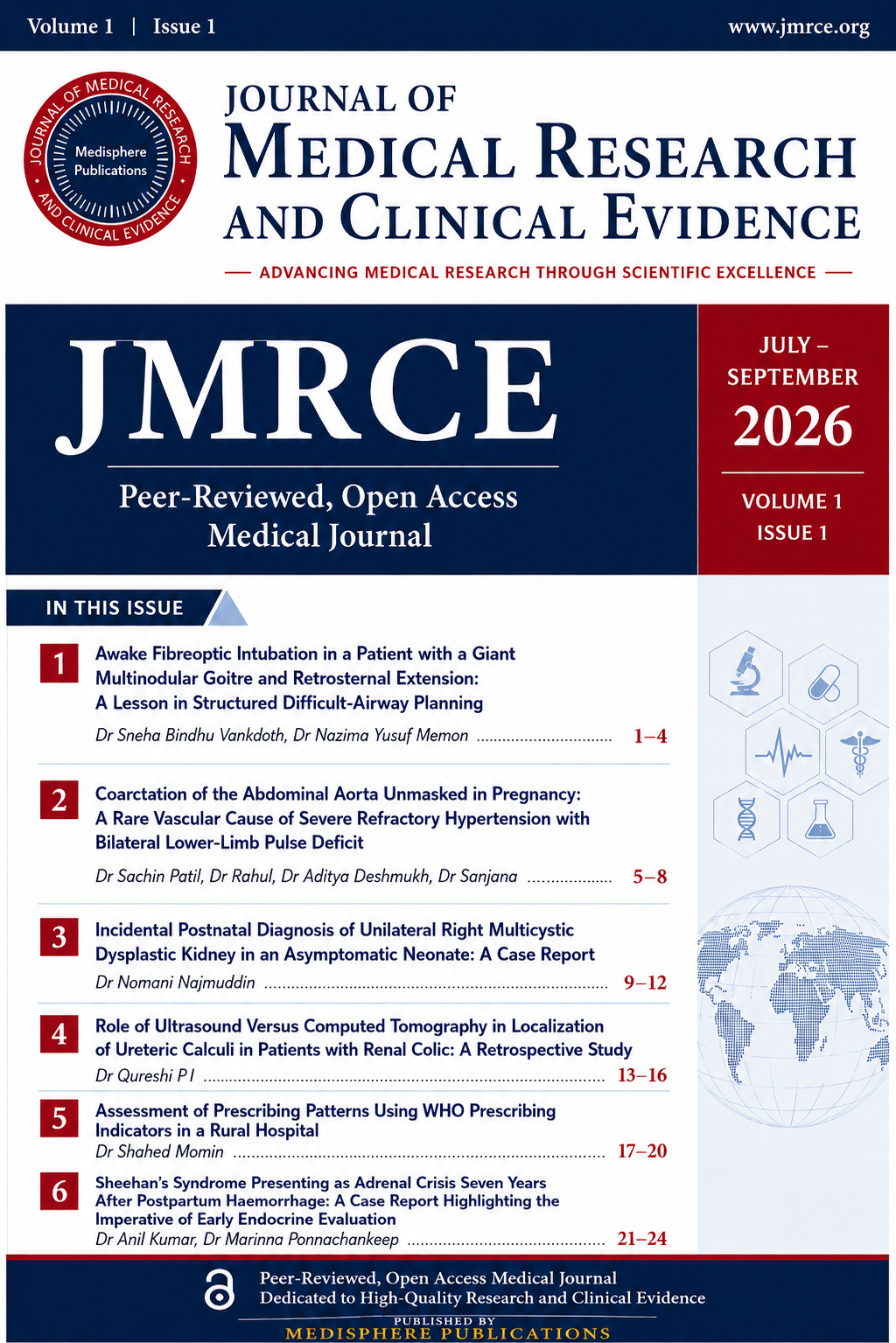
Assessment of Prescribing Patterns Using WHO Prescribing Indicators in a Rural Hospital.
Article Sidebar
Main Article Content
Abstract
Background:
Irrational drug use is a major challenge in resource-limited healthcare systems. WHO prescribing indicators provide a validated framework for measuring prescribing quality at the facility level. Data from rural outpatient settings in developing countries remain limited.
Methods:
A cross-sectional observational study was conducted among 100 consecutive outpatient prescription encounters at a rural hospital in a resource-limited setting. The five WHO core prescribing indicators were assessed: average number of drugs per prescription, percentage of drugs prescribed by generic name, percentage of encounters with an antibiotic, percentage of encounters with an injection, and percentage of drugs from the essential medicines list (EML). Patient care indicators — consultation time, dispensing time, drug availability, drug labelling, and patient knowledge of dosage — were also evaluated.
Results:
The average number of drugs per prescription was 3.8 (WHO benchmark: ≤2.0). Generic name prescribing was 56.3%, antibiotic prescribing 58.0%, injection prescribing 32.0%, and EML-based prescribing 74.5%. All five core indicators deviated from WHO benchmarks. Average consultation time was 4.2 minutes and dispensing time 62 seconds. Only 54.0% of patients could correctly state their dosage regimen.
Conclusion:
Prescribing at this rural hospital deviated from WHO standards across all five core indicators. Polypharmacy, excessive antibiotic and injection use, suboptimal generic prescribing, and incomplete EML adherence were the primary findings. Targeted educational interventions, formulary enforcement, and regular prescribing audits are needed to promote rational drug use in this setting.
Article Details

This work is licensed under a Creative Commons Attribution-NonCommercial-NoDerivatives 4.0 International License.